
If you’ve heard of Pilates but aren’t quite sure what it actually is—beyond vague references to core work and reformer machines—you’re in the right place. Pilates has evolved from a rehabilitation method used in military hospitals to a global fitness phenomenon, but its essence remains unchanged: controlled movement that connects mind and body. Let’s strip away the wellness industry mystique and get to what Pilates actually is, how it works, and what you can expect from the practice.
The Origin Story: From Joseph Pilates to Modern Studios
Joseph Pilates developed his method in the early 1920s, originally calling it “Contrology”—the complete coordination of body, mind, and spirit. Born in Germany with various childhood ailments, Joseph became obsessed with physical fitness and studied everything from yoga to martial arts to ancient Greek and Roman exercise regimens.
During World War I, while interned in England, he worked with injured soldiers and developed his rehabilitation techniques using bed springs attached to hospital beds. These improvised contraptions became the prototype for the reformer and other Pilates apparatus we use today. The goal was simple: help immobilized patients maintain muscle tone and joint mobility during recovery.
After the war, Joseph emigrated to New York City and opened a studio in a building shared with dance rehearsal spaces. Dancers discovered that his method helped them recover from injuries and improve their performance, which is partly why Pilates maintained a dance-centric reputation for decades. But Joseph’s vision was never limited to dancers—he believed everyone could benefit from his systematic approach to movement.
What “Contrology” Actually Means
The term “Contrology” captures the essence of Pilates: control over your body through conscious, precise movement. Joseph Pilates believed that modern civilization was making people weak and disconnected from their bodies. His solution was a method that demanded complete attention to how you move.
Every Pilates exercise requires you to control your movement through its entire range—no momentum, no bouncing, no mindless repetition. This conscious control develops what we now call neuromuscular coordination: your brain learning to communicate more effectively with your muscles.
The “ology” suffix indicates this is a systematic study, not just random exercises. Joseph developed a specific sequence and progression, with each exercise building on previous ones. While modern Pilates has evolved and branched into various schools of thought, this foundation remains.
Mat Pilates vs. Equipment Pilates: What’s the Difference?
One of the first decisions you’ll face is whether to start with mat or equipment-based Pilates. Both are valuable, and understanding the differences helps you choose what works for your goals and situation.
Mat Pilates
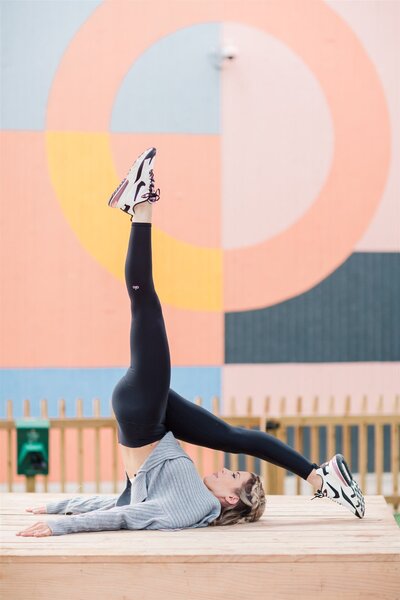
Mat work uses your body weight and gravity as resistance. It’s equipment-free (though small props like resistance bands or balls may be used) and can be practiced anywhere. Joseph Pilates developed a classical mat repertoire of 34 exercises, ordered from foundational to advanced.
Advantages:
- Accessible and affordable—no expensive equipment required
- Portable practice you can do at home, while traveling, or outdoors
- Builds serious functional strength since you’re supporting your entire body weight
- Develops body awareness without external feedback
Challenges:
- Some exercises are quite difficult for beginners without modifications
- Requires strong body awareness to maintain proper form
- Less variety in resistance options compared to equipment
Equipment Pilates (Reformer, Cadillac, Chair)
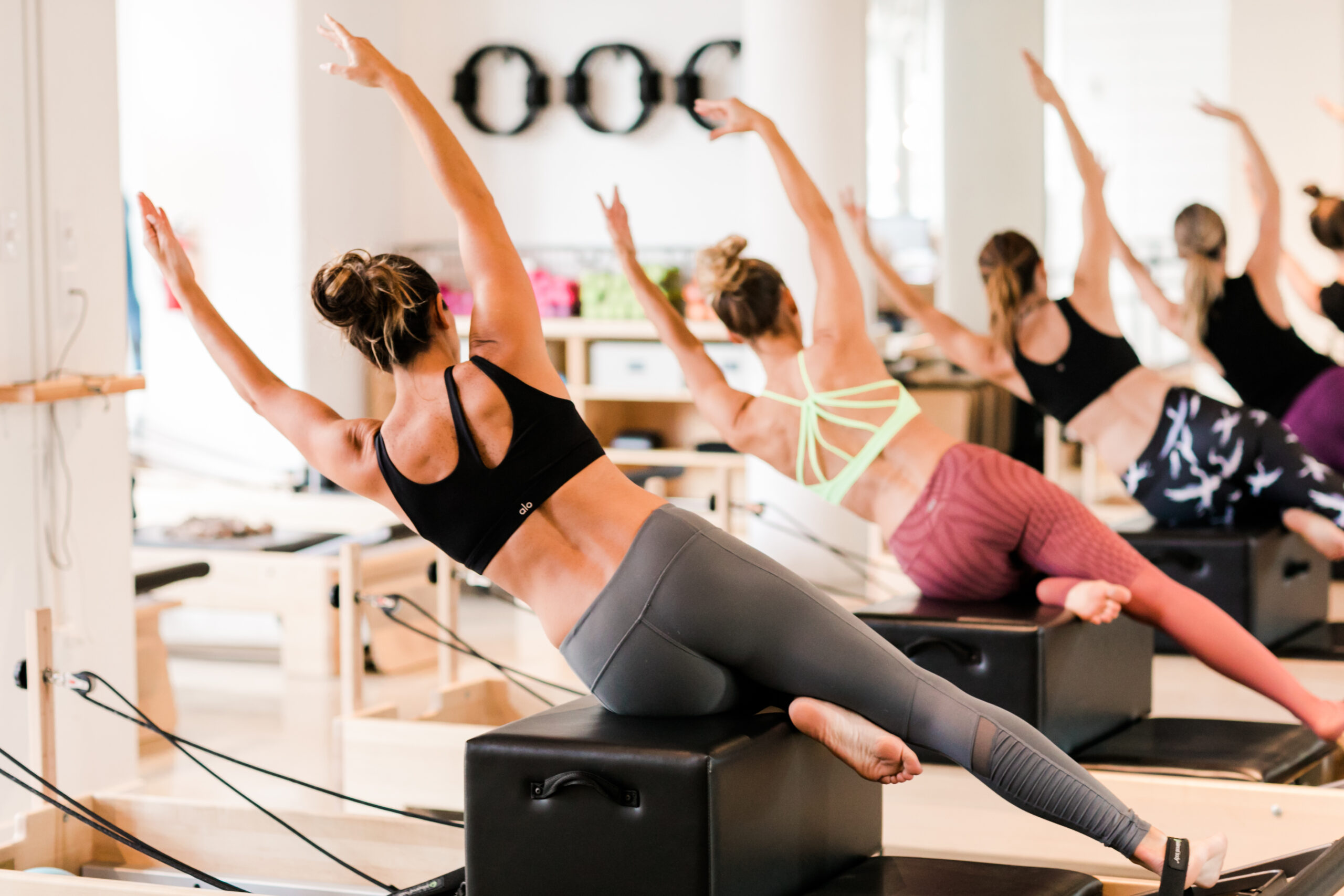
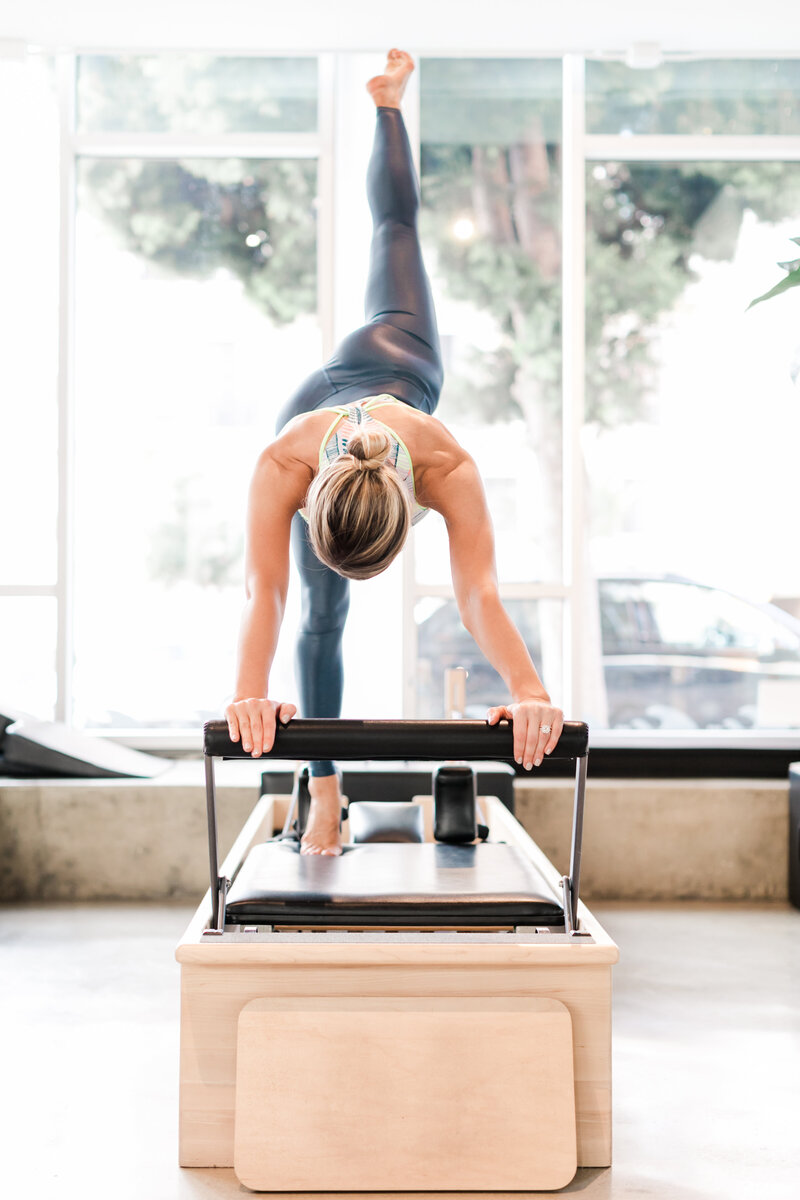
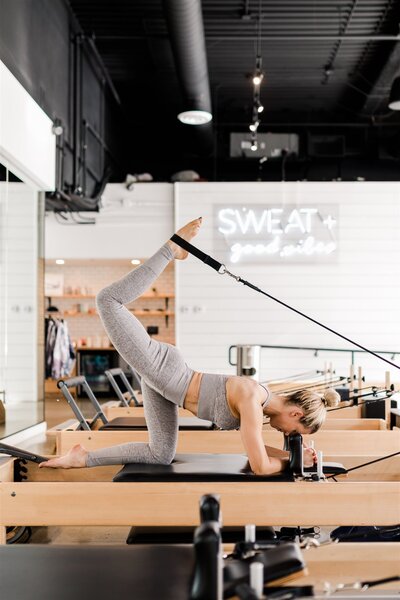
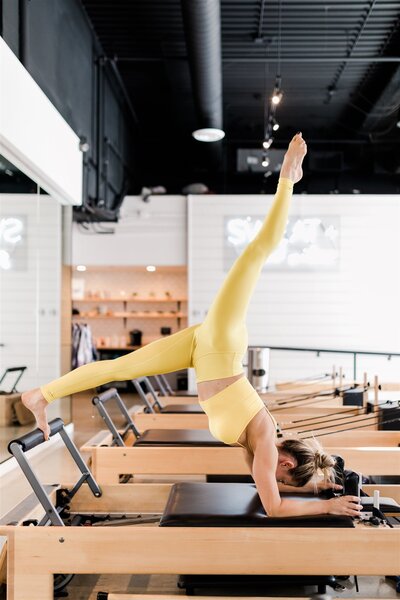
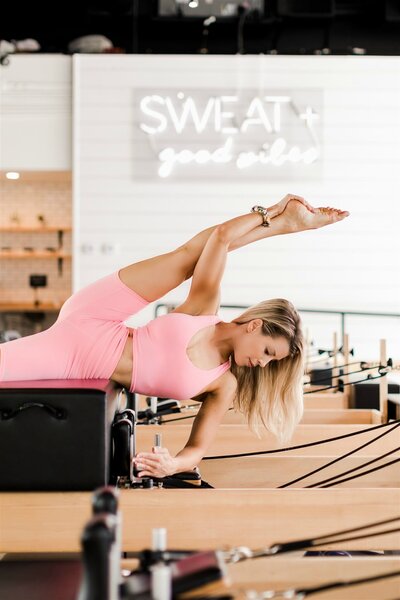
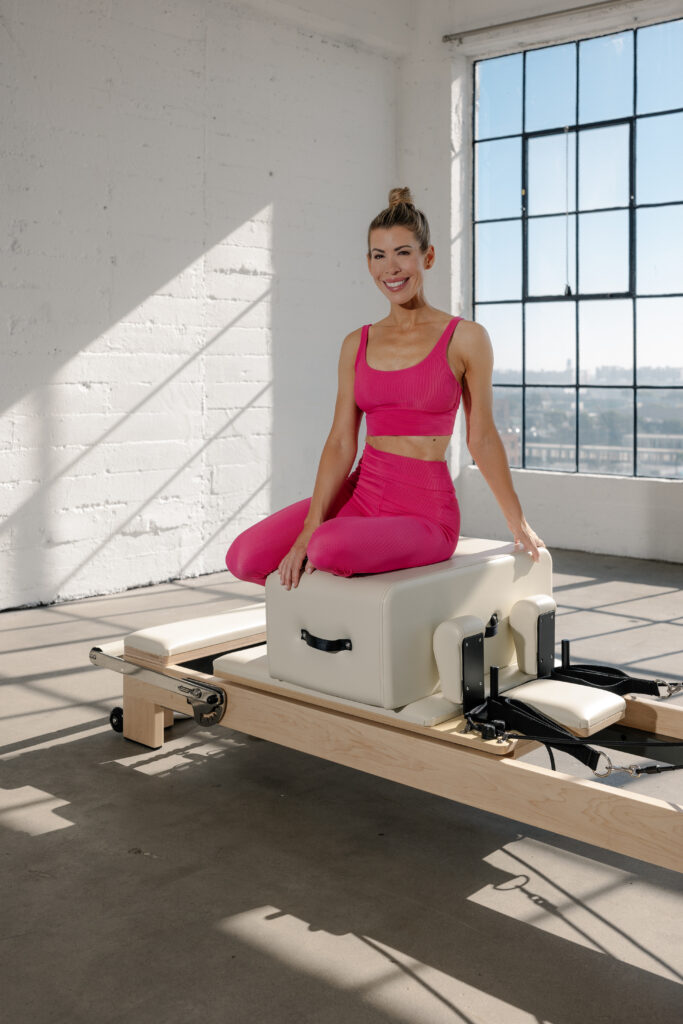
Equipment-based Pilates uses specialized apparatus with springs that provide variable resistance and assistance. The reformer is the most common—a sliding carriage with adjustable springs and straps. The Cadillac (also called trapeze table) offers overhead bars and springs for suspended work. The Wunda Chair is a compact box with a spring-loaded pedal.
Advantages:
- Springs provide feedback that helps you feel correct muscle engagement
- Adjustable resistance allows for precise progression
- Can make some exercises easier or harder depending on spring tension
- Greater variety of exercises and variations possible
- Particularly effective for rehabilitation and working around injuries
Challenges:
- Requires access to a studio or significant investment in home equipment
- Can be intimidating for beginners
- Easy to rely on equipment assistance rather than developing true strength
The Reality: Most dedicated Pilates practitioners do both. Equipment work is excellent for learning and progression, while mat work keeps you honest about your actual strength and control.
Essential Pilates Exercises Every Practitioner Should Know
These foundational exercises appear in virtually every Pilates session and form the building blocks of the method:
The Hundred
Your introduction to Pilates breath work and core endurance. Lying on your back with legs in tabletop or extended, you pump your arms while holding your head and shoulders lifted, breathing in for 5 counts and out for 5 counts, for a total of 100 counts.
What it teaches: Core endurance, breath coordination, and the ability to maintain stability while moving your limbs.
Roll-Up
Starting flat on your back, you roll up through your spine to reach toward your toes, then roll back down with control, articulating through each vertebra.
What it teaches: Spinal articulation, abdominal strength, and the difference between using momentum versus control.
Single Leg Stretch
With your head and shoulders lifted, you alternate bringing one knee toward your chest while extending the other leg, coordinating this with your breath.
What it teaches: Core stability while your legs move independently—essential for walking, running, and all functional movement.
Bridge
Lying on your back with knees bent, you lift your hips to create a straight line from shoulders to knees, then articulate back down through your spine.
What it teaches: Glute and hamstring strength, spinal articulation, and posterior chain activation.
Plank
The classic plank position, but with specific Pilates refinement: shoulders over wrists, core engaged, body in one long line from head to heels.
What it teaches: Full-body integration, shoulder stability, and sustained core engagement.
Swan
Lying face down, you press through your hands to extend your spine, opening through your chest and shoulders.
What it teaches: Back extension strength and reverses the forward-flexed posture most of us live in.
Teaser
An advanced exercise where you balance on your sit bones in a V-shape, legs extended at an angle, arms reaching forward parallel to legs.
What it teaches: The ultimate test of core control, hip flexor strength, and balance. This is the exercise that humbles everyone.
The Six Principles: How Pilates Actually Works
Understanding these principles transforms Pilates from a collection of exercises into a coherent method:
1. Concentration
Every movement demands your full mental attention. You’re not just going through motions—you’re actively thinking about which muscles should engage, how your body is positioned in space, and where you feel the work.
This intense focus creates neuroplasticity: your brain forms new neural pathways that improve motor control. Over time, better movement patterns become automatic.
2. Control
No momentum, no swinging, no flopping around. Every phase of every movement is controlled—the lifting, the holding, the lowering. This develops strength through your entire range of motion, not just at certain points.
Control also means moving at the appropriate speed for the exercise. Some movements are quick and dynamic; others are slow and deliberate. Precision in speed matters.
3. Centering
All movement originates from your core—what Joseph Pilates called the “powerhouse.” This includes your deep abdominals, pelvic floor, lower back muscles, and diaphragm. Before you move an arm or leg, your core engages to stabilize your spine and pelvis.
This principle reflects how your body actually works in real life. Your core should stabilize before your limbs move, protecting your spine and allowing for efficient force transfer.
4. Precision
The details matter. Exact positioning, specific muscle engagement, proper alignment—these aren’t perfectionism; they’re the point. Five exercises done with precision create more change than twenty done sloppily.
Precision develops body awareness. You learn to feel subtle differences in positioning and engagement, which translates to moving better in all aspects of life.
5. Breath
Pilates uses specific breathing patterns coordinated with movement. Generally, you exhale during the exertion phase (when work is hardest) and inhale during the easier phase. The breathing pattern is lateral thoracic breathing—expanding your ribcage sideways rather than belly breathing.
Proper breathing maintains core engagement, provides rhythm to movement, delivers oxygen to working muscles, and activates your parasympathetic nervous system, reducing stress.
6. Flow
Exercises transition smoothly from one to the next. There’s no start-stop quality; instead, you maintain continuous movement with grace and efficiency. This develops the quality of movement, not just the ability to get from point A to point B.
Flow also refers to the order of exercises in classical Pilates. Each exercise prepares your body for the next, creating a logical progression that systematically works your entire body.
The Mind-Body Connection: Beyond the Buzzword
The “mind-body connection” gets thrown around in wellness spaces until it loses meaning. In Pilates, it’s not abstract—it’s the concrete practice of paying attention to your body while moving.
Proprioception: Your body’s sense of where it is in space. Pilates constantly challenges this through unstable positions, small ranges of motion, and exercises requiring precise control.
Interoception: Your awareness of internal sensations. In Pilates, you learn to feel which muscles are working, where you hold tension, and how your breath affects your core engagement.
Neuromuscular Patterning: Your brain’s learned sequences for movement. Pilates rewrites faulty patterns (like overusing your hip flexors when your glutes should work) with more efficient ones.
This isn’t meditative in the traditional sense—you’re not emptying your mind. You’re filling it with specific, focused attention on your body. This concentrated practice provides mental respite from constant external stimulation while simultaneously improving how your nervous system controls movement.
What Pilates Actually Does For Your Body
Let’s be specific about benefits:
Core Strength That Functions: Not visible abs (though those may appear), but deep stabilizers that support your spine and improve all other movement.
Improved Posture: Through balanced strengthening of front and back, and increased awareness of alignment.
Enhanced Flexibility: Active flexibility—strength through your full range of motion—which is more functional than passive stretching.
Better Balance: Proprioceptive training and core stability directly improve balance, reducing fall risk.
Reduced Pain: Particularly lower back pain, through improved core function and movement patterns.
Injury Prevention: Better movement quality and balanced strength reduce compensation patterns that lead to overuse injuries.
Mental Clarity: The focused attention required provides cognitive benefits similar to meditation.
Integrating Pilates Into Real Life
Pilates isn’t just what happens during your hour-long class. The principles apply to how you move all day:
Sitting at Your Desk: Centering principle—engage your core slightly to support your spine rather than collapsing into your chair.
Walking: Flow principle—smooth, efficient gait with engaged core rather than shuffling or plodding.
Lifting Objects: Control and centering—engage your core before you lift, move deliberately, maintain alignment.
Standing in Line: Concentration and precision—notice your posture, weight distribution, and where you hold unnecessary tension.
The goal isn’t to be constantly doing Pilates exercises, but to embody the principles in how you move through life. Better movement quality during your 23 non-Pilates hours matters more than perfect form during your one-hour class.
Finding Your Pilates Practice
Start Where You Are: Beginners belong in beginner classes. The advanced exercises aren’t better—they’re just different progressions. Build your foundation properly.
Find Qualified Instruction: Look for instructors with comprehensive certifications (300+ hour programs from recognized organizations like BASI, STOTT, Balanced Body, or Peak Pilates). Teaching quality matters significantly in Pilates.
Be Patient With Progression: Pilates has a learning curve. You’re not just building strength; you’re developing new neural pathways. Give yourself several months to really understand the method.
Practice Consistently: Two to three times per week creates meaningful change. Once a week maintains; three times builds.
Combine Approaches: Use equipment work to learn and challenge yourself, mat work to test your real strength, and occasional privates to refine your technique.
The Bottom Line
Pilates is a systematic method of controlled movement that develops core strength, flexibility, body awareness, and mind-body coordination. What Joseph Pilates called “Contrology” a century ago remains relevant because the fundamentals of human movement haven’t changed.
It’s not mystical, though it can feel transformative. It’s not easy, though it’s accessible to everyone. It’s not just for dancers or women or flexible people—it’s a comprehensive system that works for any body willing to pay attention and practice consistently.
The question isn’t whether Pilates works—decades of practitioners and growing research confirm it does. The question is whether you’re willing to slow down, pay attention, and do the work. If you are, Pilates offers a lifetime practice that keeps your body strong, mobile, and moving well for decades.
Welcome to Pilates. Your body has been waiting for you to pay this much attention to it.